The Quiet Leak That Writes the Biggest Checks: What's Really Happening Around Your Chimney
Every time a major storm rolls through, homeowners are out in the yard the next morning, scanning their roofs for missing shingles or visible damage. And sure, wind and hail are legitimate threats. But if you're looking for the single detail that generates more water damage claims than any weather event, you might want to stop staring at the sky and start looking at your chimney.
Specifically, look at where the chimney meets the roof.
That junction — sealed with strips of metal called flashing — is one of the most failure-prone spots on any residential roof. And unlike a missing shingle, a flashing problem won't announce itself with obvious damage. It just lets water in, quietly, every time it rains, until one day your ceiling caves, your insulation is soaked, or your structural framing has rotted through.
By that point, you're not talking about a repair. You're talking about a claim.
Why the Chimney Is Such a Problem Spot
Chimneys are essentially a foreign object poking through your roof. They're rigid masonry structures surrounded by flexible roofing materials, and those two things expand and contract at completely different rates as temperatures change. In summer, your roof bakes and shifts. In winter, it contracts. The chimney? It does its own thing on its own schedule.
That constant movement puts enormous stress on whatever is sealing the gap between the two. Good flashing systems are designed to accommodate that movement — they're layered, they're stepped along the sides of the chimney, and they're counter-flashed into the masonry itself so water can't sneak behind them.
Bad flashing — which is more common than you'd think — is a single layer of metal slapped in place and sealed with roofing cement or caulk. It looks fine on day one. By year three, the caulk has cracked, the metal has shifted, and there's a gap just large enough to let water funnel straight into your home every single time it rains.
The Reason Nobody Catches It in Time
Here's where it gets frustrating. Chimney flashing failures are almost never caught during standard home inspections. Why? Because most inspectors are looking at the roof from ground level or from a ladder at the eaves. They're checking for obvious red flags — curling shingles, damaged gutters, missing caps. The flashing around your chimney requires someone to actually get up on the roof and get close.
Even when inspectors do make it up there, flashing issues can look perfectly fine from a few feet away. The metal might be intact. The caulk might not show obvious cracking until you press on it. The step flashing along the sides of the chimney might be partially lifted without being visibly obvious.
Meanwhile, every rain event is sending water into places it was never supposed to go.
The other problem is where that water ends up. A chimney sits near the peak of your roof, which means water infiltrating at that point has a long way to travel before it shows up anywhere you'd notice. It soaks into the decking, migrates along rafters, saturates insulation, and can travel several feet from the original entry point before it ever drips onto a ceiling. By the time you see a water stain in your upstairs hallway, the damage has already been building for months — sometimes years.
What Proper Chimney Flashing Actually Looks Like
A correctly installed chimney flashing system isn't one piece of metal. It's several, working together.
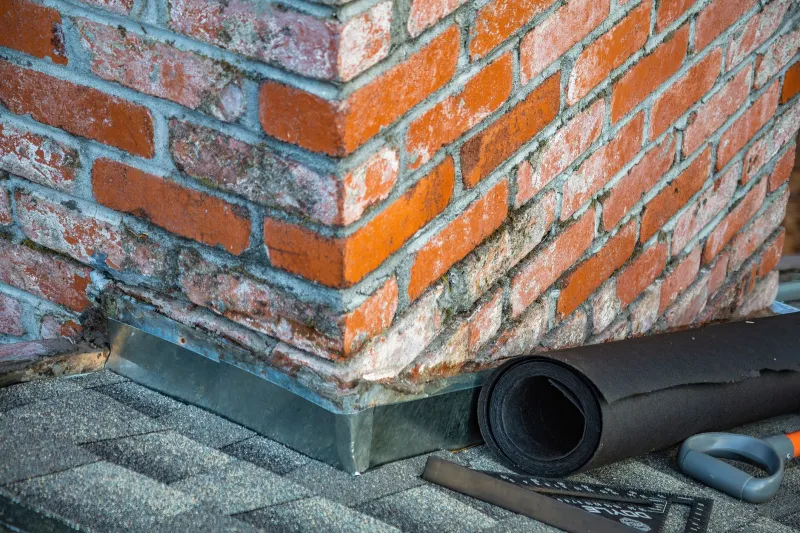
At the base of the chimney — the bottom edge where it meets the roof — there's a piece called the apron flashing. Along the sides, you have step flashing: small individual pieces of L-shaped metal that alternate with each course of shingles, so water is always directed away from the chimney rather than toward it. At the top, a saddle or cricket is often installed — a small peaked structure that diverts water around the back of the chimney instead of letting it pool there.
Then there's counter flashing, which is embedded directly into the mortar joints of the chimney itself and laps over the step flashing below. This two-layer system allows for movement without breaking the water seal.
When any of these components are missing, installed incorrectly, or sealed with nothing but caulk as a substitute for proper metal work, you've got a slow-motion disaster in progress.
Signs You Should Be Paying Attention To
You don't have to be a roofer to catch early warning signs. Here are things worth checking:
Water stains near your fireplace or on adjacent ceilings. This is the most obvious tell. Even small stains deserve investigation — don't write them off as old or unrelated.
Efflorescence on your chimney's exterior. That white, chalky residue on brick is a sign that water is moving through the masonry. It's not a flashing issue directly, but it signals moisture problems at the chimney that can compound flashing failures.
Caulk as the primary sealant. If you can safely see your flashing and it's held in place mostly by caulk rather than proper metal layering, that's a red flag. Caulk is a supplement, not a solution.
Missing or damaged chimney cap. A chimney without a cap lets rain fall directly into the flue, which contributes to moisture buildup that degrades flashing from the inside out.
Rust staining on your roof near the chimney. Rust running down from the flashing area means the metal is deteriorating — and deteriorating metal doesn't seal anything.
What It Costs to Ignore This
A chimney flashing repair done proactively — before damage occurs — typically runs a few hundred to maybe a thousand dollars depending on the size of the chimney and the scope of work needed. It's not a glamorous project. There are no before-and-after photos that impress the neighbors.
But the alternative? Water infiltration that reaches your roof decking means decking replacement. If it gets into the framing, you're looking at structural repairs. If insulation has been wet long enough, it needs to come out entirely. Drywall, paint, and interior finishes on top of that. Some homeowners have faced $15,000 to $30,000 in repairs for damage that started at a chimney flashing failure — damage that accumulated invisibly over years before anyone knew it was happening.
Insurance will sometimes cover the resulting damage, but don't count on it covering the cause. Many policies specifically exclude damage from maintenance failures, and a flashing that was never installed correctly or hasn't been touched in 20 years is a hard sell as sudden and accidental loss.
The Bottom Line
At 1BF Roofing & Exteriors, we've pulled back enough roofing material to know that chimney flashing failures are shockingly common — and shockingly preventable. The fix is rarely complicated when it's caught early. The problem is that nobody's looking for it until water has already made itself at home.
If your roof is more than five years old and you've never had the chimney flashing inspected up close, that's worth putting on your list. Not because something is definitely wrong, but because the cost of finding out is tiny compared to the cost of finding out the hard way.
Built tough. Finished right. That includes the parts you can't see from the ground.